


|
These are the answers to the quiz. |
||
1) The cephalic region of the digestive system includes the esophagus. | ||
| Not answered. It is false. The cephalic region of the digestive system includes the oral cavity and the pharynx. | ||
2) Tissues that form the digestive tract are distributed in four layers. | ||
| Not answered. It is true. The layers are mucosa, submucosa, muscularis, and serosa/adventitia. | ||
3) The smooth muscle of the digestive tract is restricted to the muscularis layer. | ||
| Not answered. It is false. Although the majority of smooth muscle is found in the muscularis layer, there are also smooth muscle cells in the deeper part of the mucosa constituting the muscularis mucosae. | ||
4) The liver and pancreas independently release their contents into the large intestine. | ||
| Not answered. It is false. Both the liver and pancreas release their compounds through the same opening, the sphincter of Oddi, into the rostral small intestine. | ||
5) La lengua está formada por músculo estriado esquelético. | ||
| Pregunta sin contestar. Es verdadero. Las fibras musculares de la lengua son alargadas, estriadas y con los núcleos localizados en la periferia celular, además de ser de contracción voluntaria. | ||
6) The tongue is joined to the bones by tendons. | ||
| Not answered. It is false. The tongue is not anchored to the oral cavity by tendons. | ||
7) The tongue epithelium is stratified squamous. | ||
| Not answered. It is true. However, some animal species may show keratinized squamous stratified epithelium because they eat hard and rough food. | ||
8) Taste is processed in the gustatory buds. | ||
| Not answered. It is true. The gustatory buds are sensory structures mostly found in the tongue papillae. | ||
9) Gustatory buds are found in the filiform papillae. | ||
| Not answered. It is false. Gustatory buds are present in the lateral walls of the calyciform and at the apical part of the fungiform papillae. | ||
10) Different tastes are detected by specific regions of the tongue, following the regionally distribution of the different type of papillae. | ||
| Not answered. It is false. Although the different types of papillae are differentially distributed on the tongue surface, gustatory buds that detect the different flavors are intermingled throughout the tongue. That is, a region of the tongue may detect all flavors.. | ||
11) Salivary glands are endocrine glands because they release into the oral cavity. Las glándulas salivales son glándulas endocrinas, puesto que secretan al interior de la cavidad bucal. | ||
| Not answered. It is false. Salivary glands are exocrine glands because they release their content to the exterior of the body (onto the oral epithelium). The content of endocrine glands ends up in the bloodstream. | ||
12) There are three major salivary glands. | ||
| Not answered. It is true. The submaxillary, parotid, and sublingual glands are the major salivary glands. | ||
13) Accessory salivary glands are small glands. | ||
| Not answered. It is true. They are dispersed through the submucosa of the oral cavity. | ||
14) The morphology of the secretory part of the salivary glands is alveolar. | ||
| Not answered. It is false. The secretory cells of salivary glands are organized in acini. That is, acinar organization. | ||
15) Salivary glands are serous glands. | ||
| Not answred. It is false. They are both serous and mucous, and some of them show mixed acini (with mucous and serous cells in the same acinus). | ||
16) LLubrication and starting food degradation are functions of the saliva. | ||
| Not answered. It is true. Saliva is also involved in keeping the oral cavity hydrated, and contains immunoglobulins, growth hormones, and other compounds. | ||
17) The tooth crown is the part inserted in the maxillary bone. | ||
| Not answered. It is false. The part of the tooth inserted in the bone is called the root, whereas the crown is the free part of the tooth. | ||
18) The enamel is the hardest and outermost layer of the tooth. | ||
| Not answered. It is true. The outermost layer of the tooth crown is made up of hydroxyapatite crystals that make the enamel the hardest structure of the body.. | ||
19) From the inside to the outside of the tooth, there are enamel, cementum, dentine, and pulp. | ||
| Not answered. It is true. The enamel is not found in the root of the tooth. | ||
20) Odontoblasts synthesize dentine and are found between the cementum and the dentine. | ||
| Not answered. It is false. Although odontoblasts produce dentine, they are found in the inner part of the dentine, between the dentine and the pulp. | ||
21) The esophagus epithelium is non-keratinized squamous stratified. | ||
| Not answered. It is true. Most mammals show squamous stratified epithelium lining the esophagus, but the epithelium can be keratinized in those species that eat hard and rough food. | ||
22) The mucosa of the esophagus contains smooth muscle. | ||
| Not answered. It is true. There are smooth muscle cells forming the muscularis mucosae in the lamina propria of the mucosa. | ||
23) There are neurons in the esophagus. | ||
| Not answered. It is true. Ganglion cells are located between the two layers of muscles in the muscularis layer of the esophagus. | ||
24) The adventitia layer separates the mucosa from the mucosa of the esophagus. | ||
| Not answered. It is false. The adventitia covers the deepest surface of the muscularis; that is, it is the inner layer of the esophagus (inner is farther from the lumen). | ||
25) The stomach is divided into four regions: cardia, fundus, pyloric antrum, and jejunum. | ||
| Not answered. It is false. The four parts of the stomach are cardia, fundus, pyloric antrum and body. | ||
26) The four layers of the stomach wall are mucosa, submucosa, muscularis, and serosa. | ||
| Not answered. It is true. The same layers can also be observed along the intestine duct. | ||
27) The stomach epithelium is stratified to protect the stomach wall from the gastric acids. | ||
| Not answered. It is false. The stomach epithelium is simple cuboidal to columnar in the stomach and simple columnar in the intestine. | ||
28) Cells that release pepsin and mucus are found in the invaginations of the stomach epithelium. | ||
| Not answered. It is true. Pepsin and mucus-releasing cells are the main types of cells in the fundus and in the neck of the stomach glands, respectively. | ||
29) The stomach is connected to the esophagus by the cardia. | ||
| Not answered. It is true. There is a clearly visible transition between the squamous stratified epithelium of the esophagus and the simple cuboidal/columnar epithelium of the cardia of the stomach. | ||
30) The jejunum is a part of the stomach. | ||
| Not answered It is false. The jejunum is a part of the small intestine. | ||
31) Digestive food is mostly absorbed in the small intestine. | ||
| Not answered. It is true. | ||
32) The folds of the intestinal mucosa are known as villi. | ||
| Not answered. It is true. Villi are present in the small intestine. In humans, there are other larger folds known as circular folds that include many villi. | ||
33) In the small intestine, there are invaginations in the mucosa known as crypts of Lieberkühn. | ||
| Not answered. It is true. The crypts of Lieberkühn are found in the rims of the villi. The stem cells that, by proliferation and differentiation, renew all the cell types of the epithelium are found in the deeper part of these crypts. | ||
34) The goblet cells are the most abundant type of cell of the small intestine epithelium. | ||
| Not answered. It is false. The most abundant cell type of the small intestine is the enterocyte. Goblet cells are abundant in the large intestine. Goblet cells are also known as mucous cells. | ||
35) The inner muscular layer of the small intestine contains muscle cells oriented parallel to the intestine's larger axis, that is, longitudinally. | ||
| Not answered. It is false. There are two layers in the muscularis: a deeper layer with cells oriented longitudinally and an outer layer (in contact with the submucosa) with cells oriented circularly, that is, as rings. | ||
36) The colon is a part of the large intestine. | ||
| Not answered. It is true. The other parts of the large intestine are the rectum and the cecum. | ||
37) The large intestine shows intestinal villi. | ||
| Not answered It is false. The large intestine shows crypts of Lieberkühn but not villi. | ||
38) The water absorption is mostly done in the large intestine. | ||
| Not answered. It is true. | ||
39) The liver functions as a digestive gland. | ||
| Not answered. It is true. One of the functions of the liver is to synthesize and release bile into the small intestine for digestion. | ||
40) Absorbed molecules after digestion are carried to the liver. | ||
| Not answered. It is true. The portal vein transports the molecules absorbed by the intestine directly to the liver for further processing. | ||
41) The Langerhans islets are the anatomical unit of the pancreas. | ||
| Not answered. It is false. | ||
42) The central vein is found at the middle point between several lobules of the liver. | ||
| Not answered. It is false. The central vein is found at the center point of each lobule of the liver. | ||
43) Portal triads of the liver are formed of one artery, one vein, and one bile duct. | ||
| Not answered. It is true. The artery is a branch of the hepatic artery, the vein is a branch of the portal vein, and the bile duct gathers the bile produced by the hepatocytes. | ||
44) Sinusoidal capillaries of the liver connect the arteries and veins of the triads to the central vein in each lobule. | ||
| Not answered. It is true. Sinusoidal capillaries are capillaries with fenestrated and discontinuous endothelium to facilitate the exchange of substances between the blood and the hepatocytes. | ||
45) Bile ducts get the endocrine products of the liver lobules. | ||
| Not answered. It is false. Bile ducts gather the bile that is released into the small intestine. Therefore, bile is an exocrine secretion. | ||
46) Hepatocytes are major detoxification cells. | ||
| Not answered. It is true. Hepatocytes contain many enzymes for toxin degradation. They are also salient cells for carbohydrate and lipid metabolism. | ||
47) Bile produced by the liver is directly released into the small intestine. | ||
| Not ansered. It is false. Bile coming from the liver is transiently stored in the gallbladder and then is released into the small intestine when digestion is at work. | ||
48) The pancreas is divided into an exocrine and an endocrine component. | ||
| Not answered. It is true. The exocrine component releases enzymes into the small intestine for digestion, and the endocrine component releases hormones, such as insulin, into the bloodstream. | ||
49) The exocrine cells of the pancreas are known as acinar cells. | ||
| Not answered. It is true. Exocrine cells are organized as acini, and they form the largest part of the pancreas. | ||
50) The pancreatic secretion contains bile salts. | ||
| Not answered. It is false. The pancreas secretion mostly contains enzymes, such as trypsin and chymotrypsin. The bile salts are produced by the liver. | ||
51) Endocrine cells of the pancreas are grouped into centroacinar lobules. Las células endocrinas del páncreas se agrupan en los lobulillos centroacinares. | ||
| Not answered. It is false. Endocrine cells are grouped in the islets of Langerhans. | ||
52) Insulin and glucagon are hormones released by the pancreas. | ||
| Not answered. It is true. The islets of Langerhans, the endocrine component of the pancreas, are formed of several types of cells. The alpha cells release glucagon, and the beta cells release insulin. Somatostatin is released by the gamma cells. | ||
F-1) This is a picture of a salivary gland stained with hematoxylin-eosin, where the clear zone pointed to with the arrows is the mucous part of the gland. 
| ||
Not answered. It is true. The mucous content of the gland is not stained with eosin, where the serous content is stained. 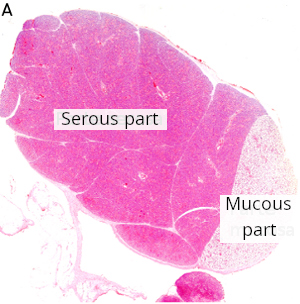 | ||
F-2) Image A shows filiform papillae, B a fungiform papilla, and C a folliate papilla. 
| ||
Not answered. It is false. A: filiform papillae, B: folliate papilla, C: fungiform papilla. 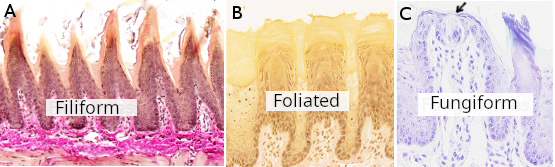 | ||
F-3) Arrows indicate the dentine of the tooth. 
| ||
Not answered. It is false. Arrows point to the periodontal membrane. 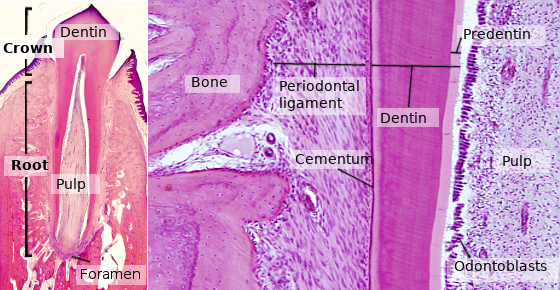 | ||
F-4) Points surround the submucosa of the esophagus. 
| ||
Not answered.. It is false. Points delimit the mucosa of the esophagus. 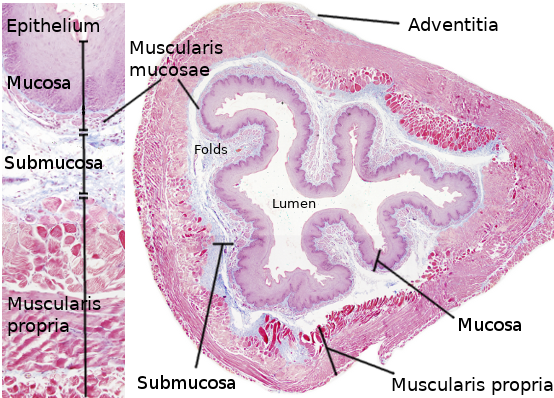 | ||
F-5) Red points enclose the gastric glands. 
| ||
Not answered. It is true. Gastric glands are invaginations of the stomach epithelium with many cell types that release their content into the invagination; from there, they reach the stomach lumen. 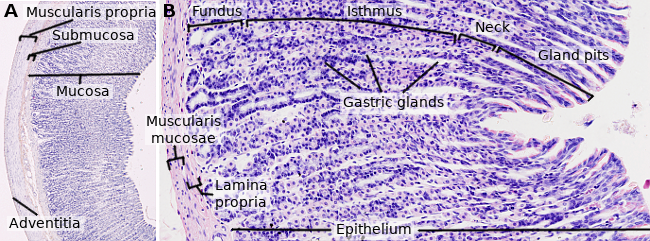 | ||
F-6) The dotted line encloses the intestinal villi. 
| ||
Not answered. It is false. The dotted line encloses the Lieberkühn crypts.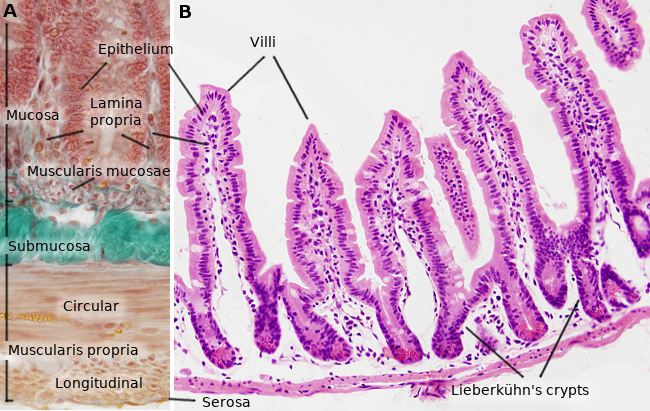 | ||
F-7) This image is from the small intestine. 
| ||
Not answered. It is false. This image is from the large intestine because it lacks villi, and the epithelium contains many goblet cells (stained in pink).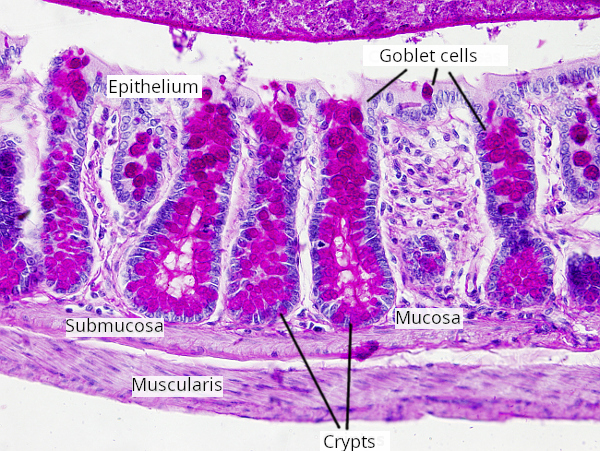 | ||
F-8) The dotted line encloses the places where the portal triads of the liver are found. 
| ||
Not answered. It is true. Portal triads are found in the vertices fo the liver lobules. 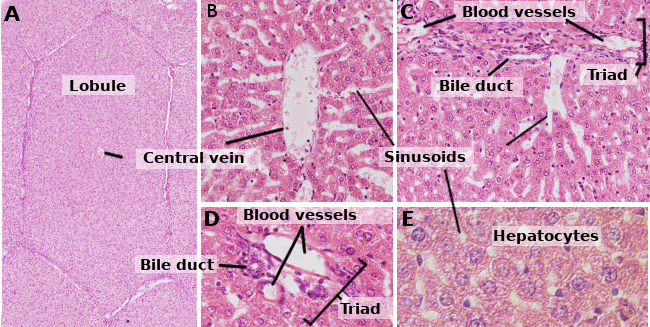 | ||
F-9) Asterisks indicate centroacinar cells of the pancreas. 
| ||
Not answered. It is false. Asterisks indicate pancreatic acini.  | ||
Results
Right answers = 0
Wrong answers = 0
Not answered = 61
Unusefull answers = 0
The score of the quiz (range between 0 and 10) = 0,0