


|
These are the answers to the quiz. |
||
1) The caulinar apical meristem is found at the insertion points of the leaves to the stem. | ||
| Not answered. It is false. The caulinar apical meristem is found at the tip of the stems and branches. The axillary buds are the meristems found at the insertion point of leaves. | ||
2) The internode is the segment of the stem found between two consecutive leaves, and it does not show lateral organs. | ||
| Not answered. It is true. Nodes are where the leaves and branches emerge from the stem, and the space between nodes is called an internode. | ||
3) Some plant species may have a stem showing primary and secondary growth at the same time. | ||
| Not answered. It is true. The secondary growth happens in the stem of many dicots and gymnosperms, whereas all plants show stems with primary growth. Thus, the older parts of the stem may undergo secondary growth, while the younger parts are still showing primary growth. | ||
4) The growing in length of stems is a consequence of the apical and intercalary meristems. | ||
| Not answered. It is true. The intercalary meristem is a main contributor to the length of the stem, whereas the growth in thickness is driven by the vascular cambium and cork cambium. | ||
5) Stems do not have stomata. | ||
| Not answered. It is false. Primary stems may have stomata and perform photosynthesis. | ||
6) In the primary stems, the cortex is an inner layer. | ||
| Not answered. It is false. The cortex is found just beneath the epidermis. | ||
7) The vascular bundle organization in primary stems is a feature that allows us to differentiate between monocots and dicots. | ||
| Not answered. It is true. Monocot primary stems show scattered vascular bundles, whereas dicot stems show vascular bundles forming the discontinuous wall of a cylinder. The discontinuities are parenchyma tissue. | ||
8) The presence of vascular cambium indicates a stem with secondary growth. | ||
| Not answered. It is true. The vascular cambium produces secondary xylem and phloem, and it is the main responsible for the growth in thickness. Es verdadero. Es el meristemo responsable de producir el xilema y el floema secundarios, y el principal responsable del crecimiento en grosor del tallo. | ||
9) Stem growth rings are produced by the periderm activity. | ||
| Not answered. It is false. It is the vascular cambium that produces the stem growth rings every year. | ||
10) The interfascicular tissue may differentiate into vascular tissue. | ||
| Not answered. It is false. This type of tissue between adjoining vascular bundles of dicots differentiates into radiomedullary parenchyma during the secondary growth. | ||
11) A typical structure of a primary stem is the periderm. | ||
| Not answered. It is false. The periderm is found in stems with secondary grwoth. It is produced by the cork cambium. | ||
12) The medullary region is larger in the thicker stems. | ||
| Not answered. It is false. The medullary region is formed during the primary growth of the stem, and there is no meristem during the secondary growth contributing new cells to this inner part of the stem. | ||
13) The dotted lines delimit the primary phloem. | ||
Not answered. It is true. | ||
14) The dotted line encloses the primary xylem. | ||
Not answered. It is true. In this image, the metaxylem and protoxylem cannot be distinguished. 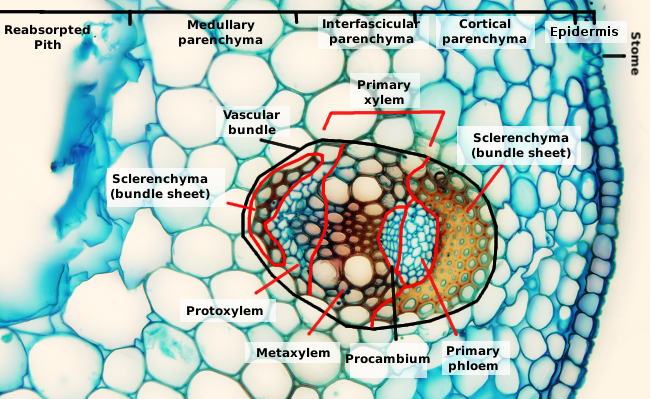
| ||
15) The dotted lines indicate the secondary xylem. | ||
Not answered. It is false. It encloses the secondary phloem, which is outer to the secondary xylem. br> | ||
16) The dotted lines delimit the primary phloem. | ||
Not answered. It is false. They enclose the secondary phloem. The secondary phloem is found between the primary phloem and the vascular cambium.  | ||


Results
Right answers = 0
Wrong answers = 0
Not answered = 16
Unusefull answers = 0
The score of the quiz (range between 0 and 10) = 0,0