


Plant tissues. Meristems
SHOOT APICAL MERISTEM
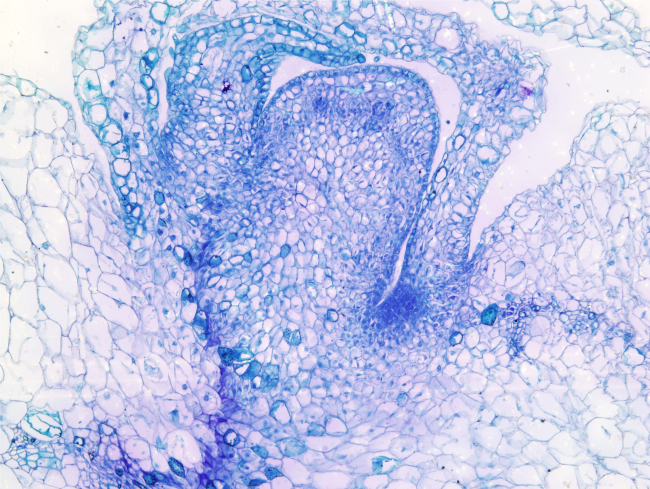
Species: grapevine (Vitis vinifera).
Technique: paraffin section stained with toluidin blue (image courtesy of Xurxo Gago).


The shoot apical meristem gives rise to all aerial organs of the plant. It consists of undifferentiated cells with a high mitotic activity, with a rate that depends on the environmental factors. For example, it may follow circadian rhythms. As in the root apical meristem, during mitosis, the cell division plane of new shoot meristematic cells is perpendicular to the longitudinal axis of the shoot, and this kind of division is referred to as anticlinal division (see figure). There are also periclinal divisions depending on the region of the meristem. The shoot apical meristem is more complex than the root apical meristem as it gives rise to all shoot tissues along with the leaf primordia and axillary buds, both located at shoot nodes. It means that it is the source of all lateral organs. The shoot apical meristem is not covered by a protective layer (Figure 1).

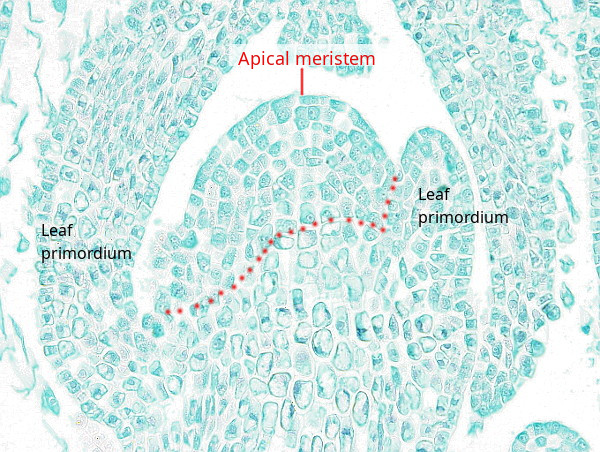
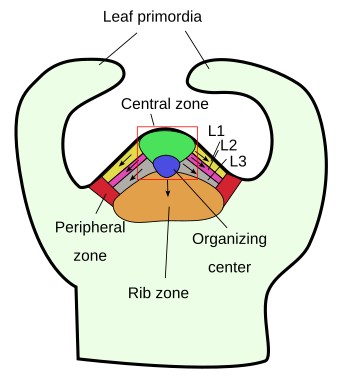
The shoot apical meristem is nowadays restricted to the undifferentiated and proliferative cell population found at the tip of the shoots. It is a dynamic structure with undifferentiated cells in the center and cells that begin differentiation at the periphery. The differentiated cells are replaced by new ones. Before differentiation, cells usually divide many times to form complex organs. The shoot apical meristem is divided into several regions with distinct behavior and particular cell lineages. In dicot plants, the meristem is organized according to the tunica- model. The tunica consists of one or two outer layers of cells in the center of the meristem. The corpus is a cluster of cells found beneath the tunica. The tunica and the corpus form the central zone of the meristem. A limited cluster of cells known as the organizing center preserves the undifferentiated condition of the initial cells, which are the stem cells of the meristem (Figure 2). The central zone is at the apical part of the meristem. It produces lateral cells with a high division rate and forms the transition zone, which is organized in three layers. The tunica gives rise to the L1 and L2, while the corpus produces the L3. In the central region of the shoot, cells derived from the corpus form what is known as the rib zone (medullary meristem). The cells begin to differentiate to form tissues and secondary meristems in the region beyond the peripheral zone. The regions of the apical shoot meristem are established by the differential gene expression patterns and concentration gradients of diffusible molecules like proteins and hormones.
The proliferation of cells in the central zone pushes the surrounding cells into the lateral layers and the peripheral zone, as well as to the region just below the central zone. After studies of the outer layer of the central zone, it has been observed that a cluster of 4 to 6 cells is the source of the radial cells that, by periclinal divisions, form the regions that expand and become the leaf primordia, nodes, and internodes. This process also happens below the corpus (under the tunica). The cells in the central zones divide more slowly than the peripheral ones. This rate seems to be related to the size of the cells. Cells divide when they exceed a certain size.
All the regions surrounding the central zone develop into other meristems with multipotent cells, including the protoderm, the ground meristem, and the provascular meristem, which give rise to the epidermis, ground tissues, and vascular tissues, respectively. The distinction between the apical shoot meristem and these new meristems lies in their potentiality, that is, the capability to differentiate into many different cells, which is large in the shoot apical meristem and more restricted in the new meristems. The initial cells are found in the outer layers of the tunica, in the embryonic axis of the shoot, and in the corpus. These initial cells are the real pluripotent cells and give rise to both multipotent cells of the central and peripheral transition regions (Figure 2).
The tunica-corpus organization is more distinct in angiosperms. In gymnosperms, it is difficult to visualize a region that can be identified as the tunica, since periclinal and anticlinal divisions happen throughout all regions of the meristem. Plants regarded as primitive, like ferns, exhibita single initial cell at the center of the meristem. Monopodial meristems are those with a cell in the apex of the meristem. Simple meristems show regions with cells dividing both anticlinaly and periclinaly, while double meristems have regions with cells undergoing either periclinal or anticlinal divisions. There are species where the regionalization of the meristem is not visible, like tomatoes.
The mitotic figures are more frequent in the regions surrounding the central zone of the meristem but are scarce in the central zone itself.
As mentioned above, once the cells are displaced from the initial cells, they start to form the transitional regions, which comprise the protoderm, ground meristem, and provascular meristem (Figure 3). These regions localize between the apical meristem and the differentiated tissues. In regions closer to the meristem, cells keep dividing, while those further from it decrease their division rate and begin to differentiate.

The protoderm gives rise to the edermis, the ground meristem to the cortex and pith, and the provascular meristem develops into the stele. The protoderm is a layer of cells that differentiates into the epidermis of the stem and leaf primordia and produces all epidermal cell types, like pavement cells, trichomes, and stomata, as the shoot apical meristem generates additional cells.
The cell rows of the provascular tissue are embedded into the ground meristem. Cells of the ground meristem grow in length and in diameter, mostly in the pith, leading to an increase of the stem diameter. The ground meristem develops into parenchyma, collenchyma, sclerenchyma, idioblasts, and laticiferous, as well as the procambium.
The provascular tissue becomes the procambium. During the early developmental stages, the residual meristem (or vacuolated meristematic tissue) develops among the meristematic strands of the provascular meristem. This meristem along with the procambium forms a cylinder. The leaf rays and some vascular bundles derived from the residual meristem. As the shoot matures, the remaining residual meristem gives rise to interfascicular parenchyma. The provascular cells show a smaller diameter, and their nuclei are visible and elongated, so this meristem can be identified by cell features.
Just below the shoot apex, located laterally, the leaf primordia are formed. The leaf primordia experience fast development, surpass the shoot tip in height, and cover it for protection. They are formed at the periphery of the shoot apical meristem, and their pattern of appearance determines the phyllotaxis, that is, the pattern of leaf organization along the stem. Each leaf primordium develops from a small cluster of cells, ranging from 30 to 100, known as founder cells. These cells form the leaf primordium outward and a cord of procambium inward.
Throughout the period between the development of one leaf primordium and the next, the apical shoot meristem grows in size, and it shrinks again as the leaf primordium is formed. The maximum size depends on the species. In regions below the shoot apex, the axillary buds form branches, leaves, and reproductive organs. At the tip of the branches, there are new apical meristems that behave as the main apical shoot meristem. However, in seedless plants, the branches are formed from the apical shoot meristem, as it can split into two equal parts. This is known as dichotomous branching.
Axillary buds, despite the term, are not associated with the leaves. They are formed close and a slightly above to the nearer leaf. This separation is more evident in monocot plants.
The apical meristem releases indoleacetic acid, which is a hormone that diffuses down the stem, inhibiting the axillary buds, therefore preventing the formation of branches near the apex. This phenomenon is called apical dominance.
-
Bibliography ↷
-
Beck CB. 2010. An introduction to plant structure and development. Cambridge University Press. ISBN-13 978-0-511-77022-7.
Risopatron JPM, Sun Y, Jones BJ. 2010. The vascular cambium: molecular control of cellular structure. Protoplasma. 247:145-161.
Truskina J, Vernoux T. 2018. The growth of a stable stationary structure: coordinating cell behavior and patterning at the shoot apical meristem. Current opinion in plant biology. 41: 83-88. DOI: http://dx.doi.org/10.1016/j.pbi.2017.09.011.
-