


Species: mouse (Mus musculus; mammal).
Technique: paraffin sections, hematoxylin-eosin staining.
The penis is the male reproductive organ. In vertebrates, it consists of three cylindrical masses of tissue that enable erection, along with the urethra, all together are enclosed by the skin. These masses of tissue are called the corpora cavernosa, consisting of two dorsal and one ventral (Figure 1). The urethra is enclosed by the ventral corpus spongiosum (also called the corpus cavernosum of the urethra).
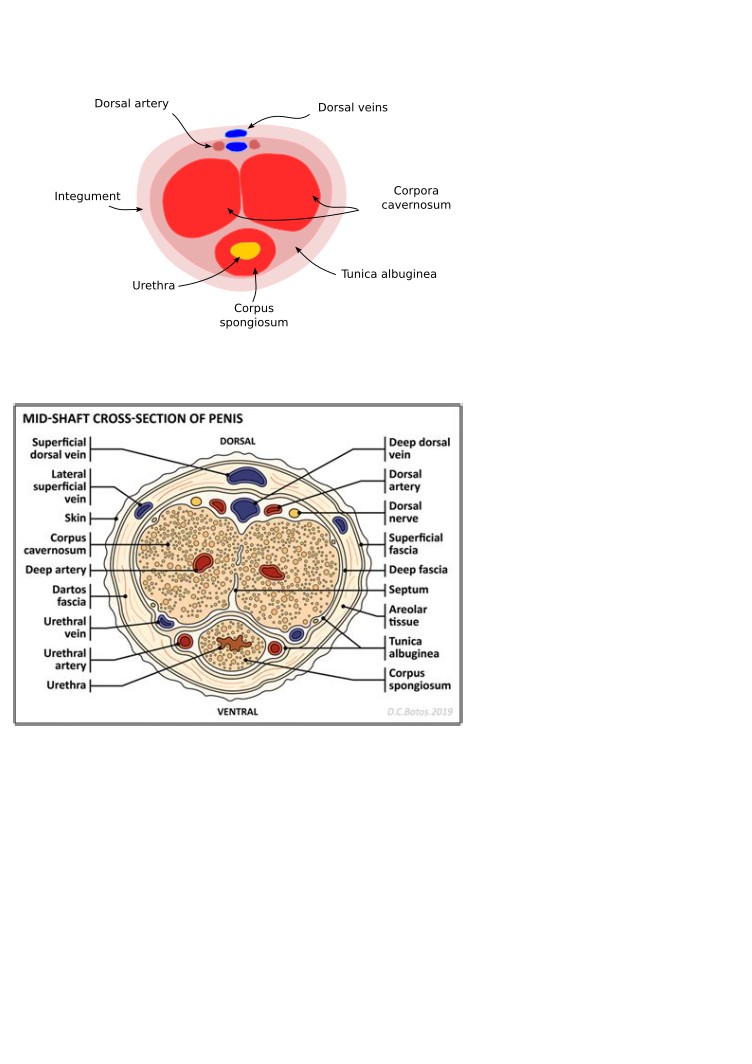
The dorsal corpora cavernosa occupy the dorsal region of the penis and extend longitudinally. Meanwhile, the corpus cavernosum of the urethra extends ventrally to the most distal part, forming a thickened, acorn-shaped structure called the glans, which covers the ends of the dorsal corpora cavernosa from the dorsal side. The glans is covered by a fold of tissue called the foreskin.
Each of the corpora cavernosa is surrounded by a layer of dense connective tissue called the tunica albuginea, which breaks through in the distal half of the penis so that the two corpora connect to one another. The corpora cavernosa consist of a network of irregular, cavernous blood vessels that are filled with or are empty of blood depending on whether the penis is erect or flaccid, respectively. The tunica albuginea significantly decreases in thickness during erection, when the corpora cavernosa are filled with blood. An artery called the central artery runs through the center of each corpus cavernosum. Smooth muscle is present in the tunica albuginea, in the trabeculae of connective tissue arranged between the vascular network, and in the sheath surrounding the central artery of the dorsal corpora cavernosa. In the corpus spongiosum of the urethra, the cavities are smaller, the tunica albuginea is thinner, and it contains more elastic fibers. The glans consists of dense connective tissue containing a network of large veins with smooth muscle arranged in a circular pattern. The arteries anastomose with the venous network located peripherally.
The skin covering the penis is thin, with a subcutaneous layer rich in smooth muscle, although there is no adipose tissue. It contains sweat glands not associated with hair follicles in the middle to distal part of the penis, and there are characteristic sebaceous glands on the inner surface of the foreskin known as Tyson’s glands.
The penis is innervated by the sympathetic and parasympathetic nervous systems. It contains numerous sensory nerves. Sympathetic and parasympathetic motor fibers innervate the smooth muscle of the trabeculae and blood vessels.