


Species: rat. (Rattus norvegicus; mammal).
Technique: paraffin embedding, staining with A) van Gieson, B) hematoxylin-eosin.
(Stainings performed by Mario Adrián de Souza and Rubén Rodríguez)
The tongue is mostly formed by skeletal striated muscle, with cells arranged in multiple directions that allow very flexible and accurate movements required for tasks like talking in humans (or making sounds in some animals) and chewing and swallowing. The tongue is coated with stratified squamous epithelium, usually non-keratinized, although some mammals can show a stratum corneum. Under the epithelium and the among muscle cells, there is connective tissue with many collagen fibers (stained in red by the van Gieson trichrome in the figure above). Besides fibroblasts, connective tissue also contains adipocytes. The dorsal surface of the tongue folds to form structures known as papillae, which show different morphologies: filiform, foliate, fungiform, and circumvallate (Figure 1). These papillae show a characteristic spatial distribution on the surface of the tongue.

Filiform papillae are the smallest and more abundant papillae (Figure 2. They are covered by squamous keratinized epithelium and do not contain taste buds (the sensory structures for perceiving tasting). Thus, they perform just a mechanical role and provide the tongue with a rough surface to move the food and sense touch and pressure.

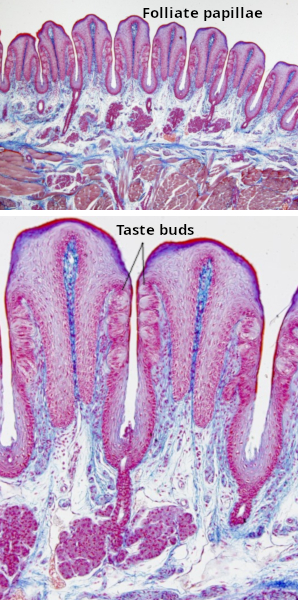
Foliate papillae are short protrusions separated between each other by parallel grooves. They have taste buds located laterally (Figure 3). In humans, they are rudimentary and are found in the posterior-lateral part of the tongue. In other mammals, foliate papillae are well-developed. For example, rabbits show the highest density of taste buds in foliate papillae.
Fungiform papillae are expansions on the tongue surface showing fungi-like shapes. They contain taste buds distributed in the distal (upper) part of the papilla.
Circumvallate papillae, or vallate papillae, are the largest papillae. They are dome-shaped and surrounded by a circular, invagnated groove containing numerous taste buds. Lingual serous glands release their contents into these grooves. Circumvallate papillae are usually located in the posterior part of the tongue.
Taste buds (Figure 4) are the structures responsible for sensing tastes. They are made up of three types of cells: sensory cells, supporting cells, and basal cells. Sensory cells, or taste receptor cells, have receptors in their apical membranes for detecting molecules carrying taste information. Basal cells renew the taste bud cell population, both sensory and supporting cells, through mitosis and differentiation. Contrary to a common misconception, the five types of tastes can be discerned in all parts of the tongue, i.e., there are no parts of the tongue that detect a particular taste. Therefore, no papilla is related to a specific type of taste. It means that taste buds for particular flavors can be found in every type of papilla and on every part of the tongue surface (Figure 5).


The evolution of the tongue and how it is organized are related to the environment and the type of food to which each animal species became adapted. Fish and some amphibian species do not show a true tongue but an outgrowth of the floor of the oral cavity, which lacks voluntary muscles. In amphibians, the true tongue appears following metamorphosis. The tongue muscular tissue evolved from the hypobranchial musculature, which in fish is used to move the gills. Therefore, it seems that the transition from the aquatic to the terrestrial environments leads to a mobile tongue. Amphibians lack a keratinized layer in the epithelium, and there is no clear differentiation between the salivary glands and the tongue. Thus, a large part of the epithelium contains secretory glands showing granules within the cells that probably perform a function similar to saliva. They also show large taste buds within this epithelium. In reptiles, the tongue epithelium is stratified and commonly keratinized. However, some species show particular features. For instance, snakes use their tongue to "smell," along with the Jacobson organ, while in chameleons the tongue is merely a mechanical organ. The keratinization level of the tongue epidermis of lizards depends on the environment. Thus, it is higher in dryer habitats. All reptiles seem to bear gustatory buds in the tongue epidermis, while terrestrial reptiles show a physical separation between glands and tongue. In birds, the lingual epithelium is keratinized. OKeratinized structures known as ventral nails occur on the tongue’s ventral surface and may also be present on its dorsal surface. These structures serve for food manipulation. Taste buds may be located very deep in the tongue and communicate with the tongue surface through canals.