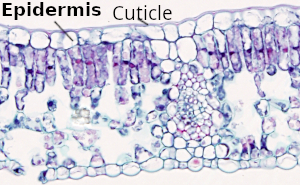

Plant tissues. Protection
EPIDERMIS

Species: buttercup (Ranunculus repens).
Technique: paraffin embedding, section stained with Alcian blue / safranin.
B) Organ: stem, epidermis with thin cuticle..
Species: potatoe (Solanum nigra).
Technique: paraffin embedding, section stained with Alcian blue / safranin.
C) Organ: stem, epidermis with rather thick cuticle.
Species: equisetum (Equisetum spp.).
Technique: paraffin embedding, section stained with Alcian blue / safranin.
D) Organ: leaf, epidermis with thick cuticle and suberin.
Species: pine (Pinus spp.).
Technique: vibratome section stained with Alcian blue / safranin.
The epidermis consists of a single layer of densely packed cells (excepting some species showing multilayered epidermis) that provides the plant with mechanical protection and prevents water loss. The free surface of the epidermal primary cell wall is coated with a layer known as the cuticle. The cuticle primarily contains cutin and waxes, which are lipidic substances synthesized and released by the epidermal cells. Epidermal cells in the root zone, responsible for water absorption, lack a cuticle. In other cases, as in potato stems, the cuticle is very thin. An medium thickness of cuticle is found in the mallow stem, while thick and very thick cuticles are present in the epidermis of pine leaves. In this case, the epidermal cells also have suberin in their cell wall.
More images